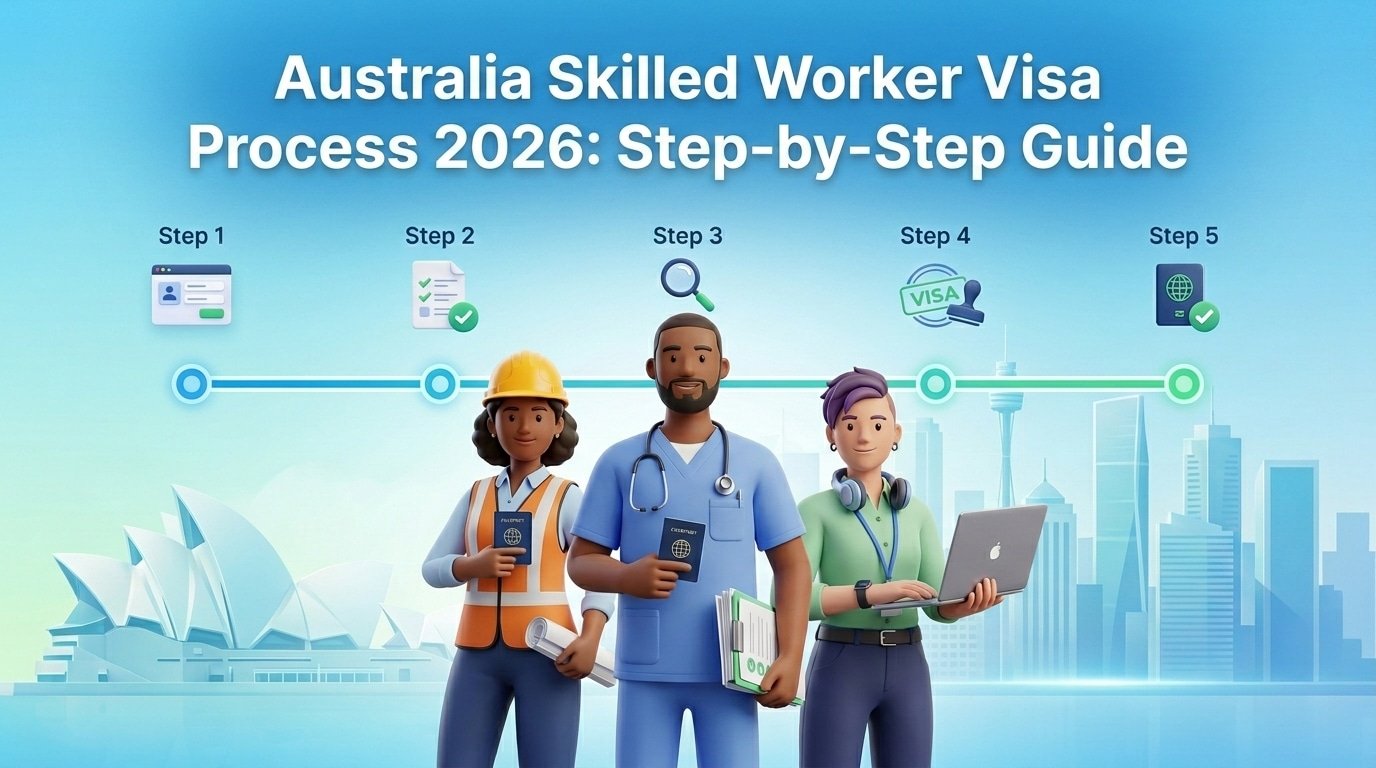
Australia remains one of the most popular destinations for skilled migrants due to its strong economy, high quality of life, and demand for qualified professionals across multiple industries. For many foreign workers, the skilled migration pathway offers a realistic route to long-term residence and career growth.
This guide explains the Australia skilled worker visa process in 2026, step by step, in a clear and practical way so you understand how the system works, what is required, and how to improve your chances of success.
What Is the Australia Skilled Worker Visa?
The Australia skilled worker visa is not a single visa type. Instead, it refers to a group of skilled migration visas designed for individuals with qualifications, experience, and skills needed in Australia’s labor market.
These visas operate on a points-based system, where applicants are assessed based on factors such as age, education, work experience, and English language ability.
Main Skilled Visa Pathways in Australia
Before going into the step-by-step process, it is important to understand the key visa subclasses under skilled migration:
1. Skilled Independent Visa (Subclass 189)
- Permanent residency visa
- No employer or state sponsorship required
- Points-based selection system
You can learn more about the skilled independent visa.
2. Skilled Nominated Visa (Subclass 190)
- The skilled nominated visa requires nomination by an Australian state or territory
- Permanent residency pathway
- Additional points for nomination
3. Skilled Work Regional Visa (Subclass 491)
- Temporary visa (up to 5 years)
- Requires regional sponsorship or family nomination
- Pathway to permanent residency
Step-by-Step Australia Skilled Worker Visa Process (2026)
Below is a simplified breakdown of how the process works from start to finish.
Step 1: Check If Your Occupation Is Eligible
The first step is confirming whether your job is on Australia’s Skilled Occupation List. Australia prioritizes occupations based on labor shortages, such as:
- Healthcare professionals
- Engineers and technical workers
- IT specialists
- Tradespeople (electricians, plumbers, etc.)
- Agricultural and regional workers
If your occupation is not listed, you may not be eligible under the skilled migration pathway.
Step 2: Complete a Skills Assessment
A skills assessment is a formal evaluation of your qualifications and work experience.
It is conducted by an approved assessing authority depending on your profession.
Example:
- Engineers → Engineers Australia
- IT professionals → ACS (Australian Computer Society)
- Nurses → ANMAC
This step ensures your qualifications meet Australian standards.
Step 3: Take an English Language Test
You must prove your English ability through approved tests such as:
- IELTS Academic or General
- PTE Academic
- TOEFL iBT
Higher scores improve your chances by increasing your points total.
Step 4: Calculate Your Points Score
Australia uses a points-based immigration system. You are assessed based on:
- Age
- Education
- Work experience
- English proficiency
- State nomination (if applicable)
- Partner qualifications (if relevant)
Minimum requirement is usually 65 points, but higher scores increase invitation chances.
Step 5: Submit an Expression of Interest (EOI)
Once your details are ready, you submit an Expression of Interest (EOI) through the SkillSelect system. This is not a visa application yet — it is a formal declaration of your interest in migrating. Your profile is then ranked against other applicants.
Step 6: Receive an Invitation to Apply (ITA)
If your EOI is competitive, you may receive an Invitation to Apply (ITA) for a visa. Invitations are issued based on:
- Occupation demand
- Points score
- State nomination (if applicable)
- Labor market needs
Not all applicants receive invitations immediately.
Step 7: Submit Your Visa Application
After receiving an ITA, you can submit your full visa application. You will need to provide:
- Identity documents
- Skills assessment results
- English test results
- Work experience evidence
- Health examination results
- Police clearance certificates
Accuracy is very important at this stage. Missing or false information can lead to refusal.
Step 8: Health and Character Checks
All applicants must undergo:
- Medical examinations
- Background (police) checks
This ensures you meet Australia’s health and security requirements.
Step 9: Visa Processing
After submission, your application enters processing. Processing time depends on:
- Visa subclass
- Occupation demand
- Application completeness
- Background checks
Some applications are processed faster if the occupation is in high demand.
Step 10: Visa Decision and Approval
If successful, you will receive a visa grant notification. This allows you to:
- Live and work in Australia
- Travel in and out (depending on visa type)
- Begin your migration journey
Tips to Improve Your Chances
Increase your points score
- Improve English test results
- Gain more work experience
- Obtain higher qualifications
Target in-demand occupations: Focus on sectors with shortages like healthcare and IT.
Consider regional migration: Regional visas often have higher invitation chances.
Ensure accurate documentation: Errors in applications can cause delays or refusals.
Apply early and monitor updates: Immigration policies change regularly.
Common Mistakes Applicants Should Avoid
- Submitting incomplete documents
- Choosing the wrong occupation code
- Underestimating English requirements
- Ignoring state nomination rules
- Using unverified agents or sources
Frequently Asked Questions
Do I need a job offer for a skilled visa?
Not always. Some visas like Subclass 189 do not require a job offer.
What is the minimum points required?
Generally, 65 points is the minimum, but higher scores improve chances.
How long does the process take?
Processing times vary depending on visa type and applicant profile.
Can I apply from outside Australia?
Yes, most skilled visas allow offshore applications.
Conclusion
The Australia skilled worker visa process in 2026 is structured, competitive, and based on a clear points system. While it may seem complex, breaking it into steps makes it easier to understand and prepare for.
Applicants who focus on improving their qualifications, targeting in-demand occupations, and submitting accurate documentation have a stronger chance of success.
For the best outcome, always rely on official immigration sources and ensure your application aligns with current Australian migration requirements.
Disclaimer: This article is for informational purposes only. Immigration rules may change. Always confirm details from the official Australian Department of Home Affairs portal.
